


Indian households hold an estimated 34,600 tonnes of gold worth $3.8 trillion—nearly 89% of India’s GDP—fueled by a 62% price surge to around ₹1.25 lakh per 10g in 2025, as per Morgan Stanley reports which are shared widely on social media.
India’s gold obsession peaks during wedding seasons and festivals, with demand surging 20-30% annually as families splurge on jewellery symbolizing prosperity and security. Yet, amid this cultural fervor, a key question arises: how much gold can you legally hold at home without tax worries? This post unpacks CBDT presumptive limits for jewellery during income tax raids, plus documentation tips for excess holdings.
Gold Holding Limits in India
India imposes no absolute legal limit on gold held at home, but income tax guidelines set presumptive thresholds below which individuals face no scrutiny or no need to justify ownership during IT raids.
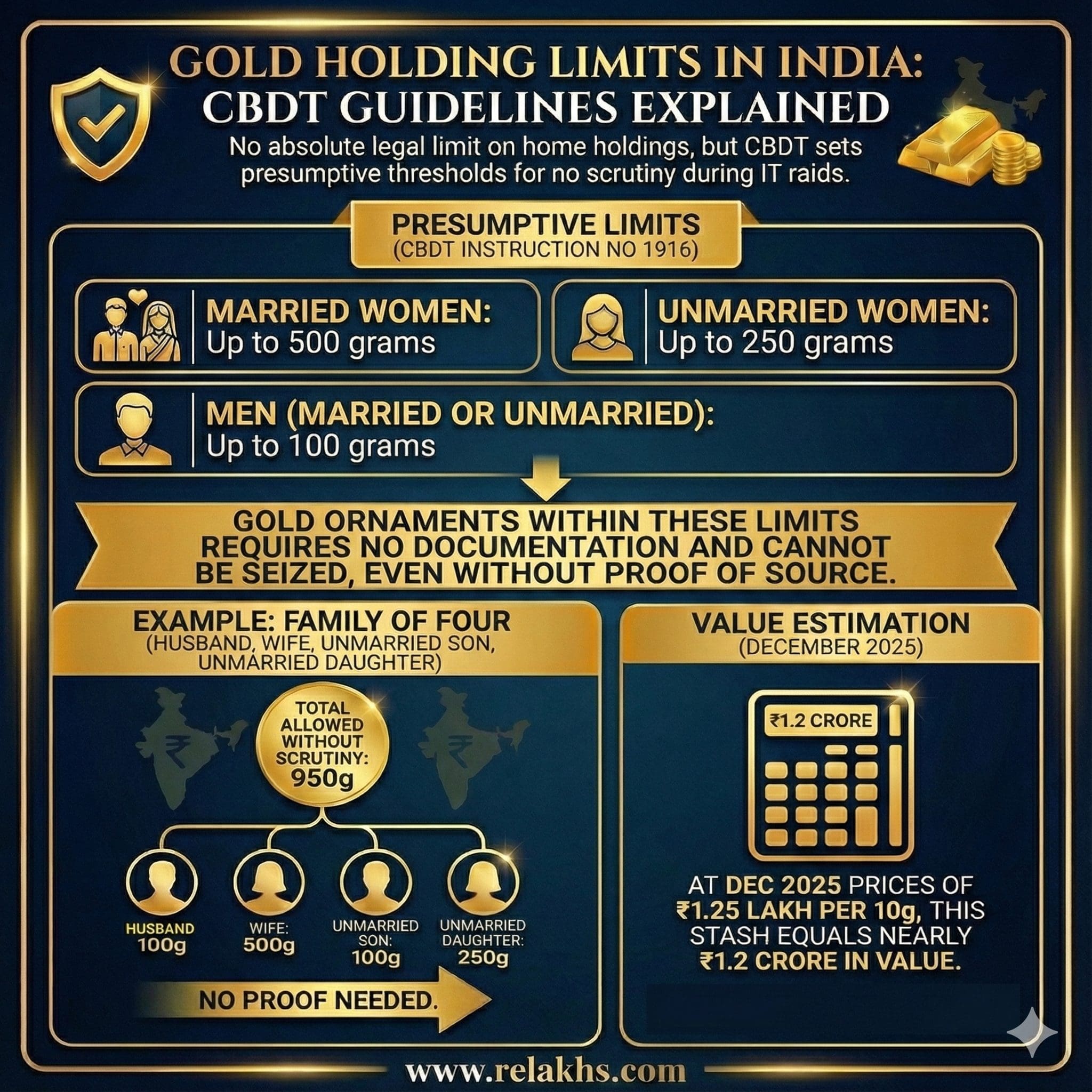
Presumptive Limits
These Central Board of Direct Taxes (CBDT) guidelines apply to gold jewellery and ornaments per person:
- Married women: Up to 500 grams.
- Unmarried women: Up to 250 grams.
- Men (married or unmarried): Up to 100 grams.
| Category | Gold Limit (grams) |
| Married woman | 500 |
| Unmarried woman | 250 |
| Man (married or unmarried) | 100 |
Gold within these limits requires no documentation and cannot be seized, even without proof of source.
Example -1
Under CBDT guidelines, a family of four—husband (100g), wife (500g), unmarried son (100g), and unmarried daughter (250g)—can hold 950g of gold jewellery without raid scrutiny or proof. At December 2025 prices of ₹1.25 lakh per 10g, this stash equals nearly ₹1.2 crore in value.
(The average price of 24-carat gold in India between December 1 and December 21, 2025, was approximately ₹133,085 per 10 grams, while the average for 22-carat gold was about ₹121,990 per 10 grams.)
Example -2
An Income Tax search was carried in the premises of Mr. Reddy at his residence and the bank lockers on 1st Dec, 2025. Gold jewellery of 1300 grams was found from the residence of the Mr. Reddy as well as his bank lockers. Out of this 1300 gms, he has inherited 200gms of Gold from his mother through a WILL.
So, how much Total Jewellery that can be seized and disallowed by the IT department?
| Particulars | Jewelry Weight (in gms) |
| Married Lady (Ms. Reddy) | 500 |
| Male member (Mr Reddy) | 100 |
| Male member (Mr Reddy’s son) | 100 |
| Unmarried lady (Mr Reddy’s daughter) | 250 |
| Gold Inherited from Mr Reddy’s’ mother through WILL (valid document) | 200 |
| Total allowed Jewellery that cannot be seized | 1150 |
| Total Gold holdings found | 1300 |
| Total Jewellery that can be seized and disallowed (unexplained holding) | 150 |
What Happens If You Go Beyond 950 gms? What documents prove gold ownership?
Documents proving gold ownership beyond CBDT presumptive limits (500g married woman, 250g unmarried woman, 100g man) include purchase invoices, inheritance records (refer example-2) , and legal transfer deeds, ensuring holdings align with declared income during raids or scrutiny.
Purchase Proofs
Tax invoices from jewellers with PAN details validate bought gold; retain originals showing date, weight, value, and GST. Bank statements linking payments to purchases strengthen evidence. Purchases over ₹2 lakhs mandatorily record PAN, aiding traceability.
Inheritance/Gift Proofs
Gift deeds, wills, family settlement deeds, or succession certificates establish transfer from prior owners. If unavailable, prior owner’s receipts or circle rates suffice, alongside family status, customs, and ITR history for validation. Hindu Undivided Family (HUF) records apply collectively.
Income Tax Return
Individuals with total income over ₹1 crore must disclose silver and gold holdings in Schedule AL (Assets & Liabilities) of ITR from FY 2025-26. Always retain bills, especially for cash purchases under ₹2 lakhs per transaction per Section 269ST.
“Declare in Schedule AL (now ₹1cr threshold, up from ₹50L). Schedule AL disclosure threshold rose to ₹1 crore total income for ITR-2/3 in FY 2025-26.”
How much Tax on Unexplained Gold?
Without justification, excess gold may be treated as unexplained income, taxed at 60% plus surcharge and cess (effective ~78%), plus a 10% penalty.
What about Silver holdings?
- There is no similar provision allowing up to 950 grams (or any fixed quantity) of silver ornaments to be held in a household without questions from tax authorities during raids.
- All silver holdings demand documentation like bills or inheritance records; unexplained amounts risk tax liability plus penalty, with Schedule AL disclosure mandatory for income over ₹1 crore in FY 2025-26.
Final Note
These CBDT presumptive limits apply strictly to gold jewellery and ornaments only—not gold bars, coins, or bullion, which always require full documentation during raids regardless of quantity.
No absolute legal limit caps gold ownership for individuals or households in India — any amount is fine with solid proof like bills, inheritance deeds, or ITR records matching declared income.
Declare excess jewellery in Schedule AL (ITR-2/3) if income >₹1 crore to avoid scrutiny. These CBDT thresholds cover only ornaments, not bars/coins.
Consult a tax advisor for personalized advice amid 2025’s soaring prices.
(Post first published on – 22-Dec-2025)

