


Every admission season, thousands of families in India sit over the same question: “Engineering or Medicine – which is better for my child?” The dilemma feels eternal, but the reasons behind it keep changing with headlines, salary trends and seat counts.
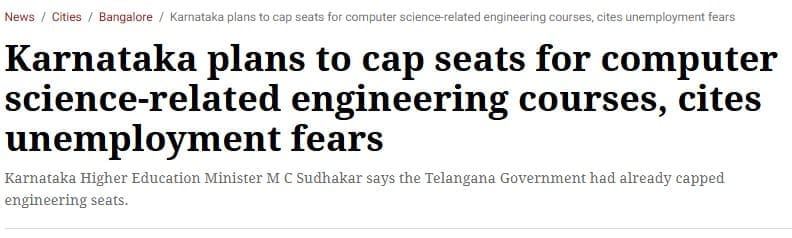
Over the last two decades, the pendulum has swung wildly. For years, the IT boom made engineering look like the golden ticket. Today, with medical seats expanding and computer science seats facing caps in some states, medicine is suddenly back in fashion.
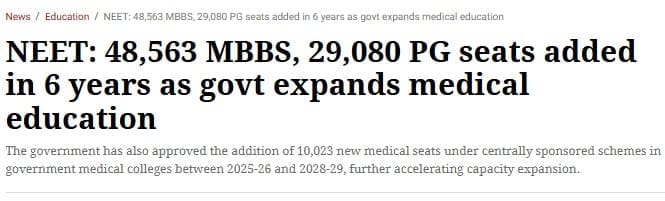
Yet in all this noise, I believe one small voice is often missing at the decision table – the child’s genuine interest and core strengths.
Engineering vs Medicine: The Eternal Dilemma
For almost 15–20 years, the default answer to “What after 12th?” was: “Engineering kar lo, phir dekhenge.” IT companies were hiring aggressively, foreign postings were the dream, and starting salaries looked far more attractive than most other professions.
Several things followed:
- Students who were actually confused between medicine and engineering took the “safer” engineering route because the job market looked lucrative.
- Even those with no particular love for maths, coding or core engineering disciplines joined because “everyone is doing it” and “IT mein scope hai.”
- Families started seeing engineering not as a profession, but as a general-purpose ticket to a white-collar job.
The result: a generation of graduates who often discovered, too late, that they were sitting in the wrong classroom for four long years.
The 2/3rd Problem: Engineers Chasing IT Jobs
Another distortion quietly crept in. Today, nearly two‑thirds of engineering students, irrespective of branch, either work or want to work in IT, chasing paychecks rather than their own discipline.
Why?
- IT roles offered better starting pay compared to many core engineering jobs.
- Campus placements were dominated by software and IT services companies.
- Friends and seniors in IT shared success stories, while core sector opportunities seemed fewer and slower to grow.
Over time, two realities emerged on the ground:
- A large share of engineering seats, especially in certain colleges and branches, struggled to attract serious, interested students.
- Many engineering graduates entered the job market with a degree in one field, but skills and work expectations in a completely different field.
When two‑thirds of engineering students are chasing one sector, not because of love for technology but because of salary attraction, something is fundamentally misaligned.
The New Swing: Medicine as the “Safer” Bet
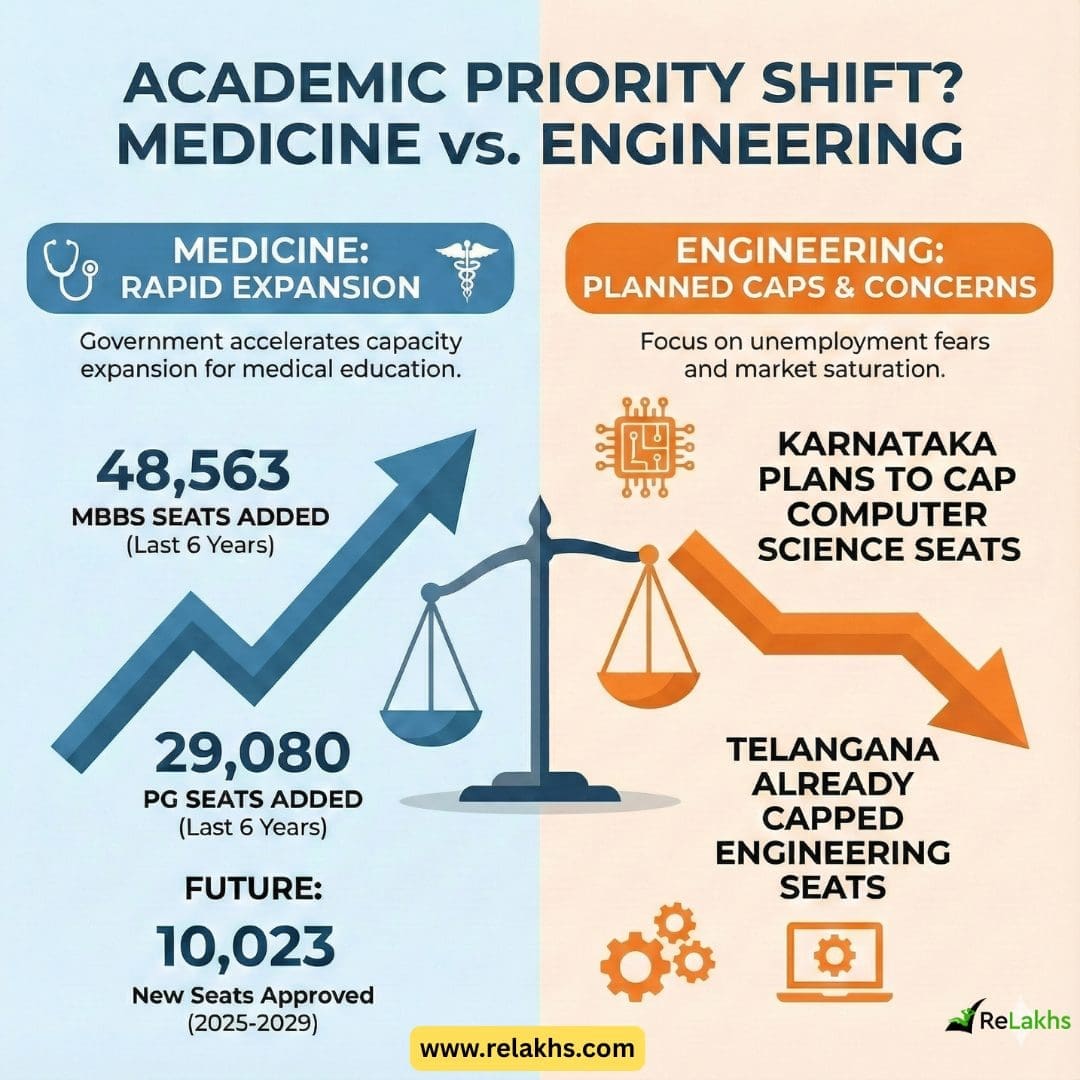
In the last few years, the narrative has started to shift. With news about IT layoffs, automation, and saturation in some engineering streams, families in that same “confused” band are tilting towards medicine.
Some clear trends are visible:
- Medical seats have expanded significantly, giving an impression that healthcare offers more stability and demand.
- Parents are increasingly willing to consider expensive payment seats or private colleges if that secures an MBBS tag.
- The logic has changed from “engineering is safe” to “doctor ka scope hamesha rahega.”
But here is the key question: is medicine really the child’s calling, or just the next “safe” box to tick?
Because medicine is not just another professional course. It demands long years of study, emotional resilience, and a strong service mindset. Choosing it only for perceived job security can be as risky as choosing engineering only for salaries.
The Real Root Cause: Confusion and Herd Mentality
Look closely and the core problem is not engineering or medicine. The real issues are:
- Confusion at the decision stage: Many students do not get enough exposure, counselling, or self-assessment to understand their interests and strengths.
- Herd mentality: Choices swing with the crowd – first towards engineering because IT was booming, now towards medicine because it appears more stable.
- Over‑focus on salary: Career decisions are being driven by starting pay and short‑term job trends, rather than long‑term fulfillment and competence.
When a decision worth 30–40 years of a person’s working life is taken based on 3–4 years of job market headlines, regrets are almost guaranteed.
If Your Child Loves Engineering
If your child genuinely loves engineering – enjoys maths, physics, problem-solving, tinkering with gadgets, coding, or building models – then:
- Encourage her to explore different branches and understand what each one actually does.
- Help her see beyond IT jobs: manufacturing, design, research, core sector roles, product companies, and even entrepreneurship.
- Guide her to build strong fundamentals, practical skills, internships and projects that deepen her capabilities.
The job market may go up and down, but a strong engineer with clarity, skills and flexibility rarely remains unemployed for long.
If Your Child Loves Medicine
If your child feels drawn to biology, human anatomy, patient care, and is prepared for long years of study and delayed gratification:
- Help her understand the reality of medical education – intense workload, entrance competitiveness, fees, and the emotional side of dealing with illness and death.
- Discuss not only MBBS, but also possible paths later: specializations, super‑specializations, research, public health, tele‑medicine and more.
- Ensure the decision is driven by genuine interest, not just the allure of social status or perceived job security.
Here too, those who enter with the right mindset tend to thrive, while those who enter out of compulsion often burn out.
What Actually Matters in the Long Run
Across professions, some fundamentals never change. Over a 30–40 year career, three things matter far more than temporary market conditions:
- Strong passion and genuine interest
- Core competency and skill depth
- Adaptability and continuous learning
In short, a mediocre engineer who chose the field under pressure may struggle despite an apparently “better” market, while a passionate engineer can carve out opportunities even in tougher times. The same is true for medicine.
Practical Steps for Parents and Students in Dilemma
Instead of asking “Which is better – engineering or medicine?”, it helps to ask better questions:
- What subjects does the child naturally enjoy and perform well in?
- In which activities does the child lose track of time – solving problems, building things, reading about diseases, helping others?
- What kind of work environment does the child imagine: labs and machines, code and systems, clinics and hospitals, or something entirely different?
- Is the child prepared for the specific lifestyle demands of each path – long shifts, emergencies, project deadlines, continuous exams?
Families can also:
- Use aptitude and interest assessments as one input (not the only one).
- Talk to professionals in both fields about their day‑to‑day reality, not just their salaries.
- Keep a long‑term view: “Will my child be happy and growing in this field 10–20 years from now?”
Final Thoughts: Let the Child Choose, Not the Trend
Seat counts will change. Policies will change. Industries will go through booms and slowdowns. Today it is IT, tomorrow it may be AI, healthcare, climate tech or something completely new.
But one principle should remain constant: if a child truly wants to do engineering, let her do engineering. If she truly wants to do medicine, let her do medicine. The role of parents and educators is to guide, inform and support – not to impose decisions based on fear or fashion.
In the long run, passion, interest and core competency compound much more reliably than any salary trend or market hype. Careers built on clarity and conviction always outlast careers built on confusion and crowd pressure.
“Passion + interest + core competency > any short‑term salary trend.“
“Seats can be capped or expanded. Purpose cannot.”
Continue reading :
(Post first published on : 18-Dec-2025)

