


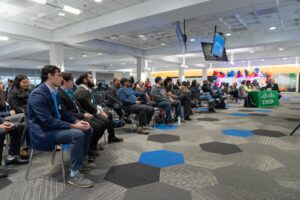
On December 8, we hosted the first Empower & Connect Summit at Cisco’s campus in Raleigh, NC, bringing together partners, innovators, and communities to explore how technology can drive meaningful social impact.
At the center of that energy was the Community Innovation Challenge. In partnership with Net Impact we invited students from around the world to pitch their boldest ideas: how would they use Cisco technology to address critical challenges in their own communities? We received 84 proposals from 12 countries, with the top five teams advancing to present in person at the Summit. There, a panel of experts evaluated their ideas based on their understanding of community needs, innovative use of technology, and potential for real-world results.
What struck me most wasn’t just the technical sophistication of their proposals — it was how deeply these students understood the communities they were designing for, and how they positioned technology as a path to opportunity.
Bold solutions, big impact: Meet the 2025 Innovation Challenge Winners
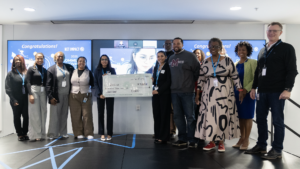
First place: DinéLink – $10,000
Mahima Subramaniyan and Devangna Jadeja, Arizona State University
Spanning 27,000 square miles of rugged terrain across Arizona, New Mexico, and Utah, the Navajo Nation is the largest reservation in the United States. Yet for nearly two-thirds of the more than 160,000 people who live there, reliable internet remains out of reach. [1]
Mahima and Devangna’s proposal tackled this head-on with a vision for digital sovereignty through DinéLink, a community-owned network designed to withstand the terrain and serve the people who live there. They proposed using Cisco Ultra-Reliable Wireless Backhaul to bypass geographic barriers and reach areas where fiber isn’t viable, paired with Meraki access points and security appliances to provide both connectivity and network management at scale. Solar-powered hubs would ensure reliability in remote areas, while Catalyst infrastructure would reduce dependency on traditional fiber networks. But what set DinéLink apart was the emphasis on building for the long-term by proposing to embed Cisco Networking Academy training through Diné College and Navajo Technical University, so the community doesn’t just get connectivity, but also the workforce to maintain and expand it themselves.
Second place: HealthHorizons – $5,000
Priya Rao (University of Connecticut), Julia Kuang (Wellesley College), Grace Chen (Swarthmore College)
In Greene County, Alabama, just three practicing physicians serve the entire population. Like many remote areas, sparse infrastructure means limited broadband access, putting telehealth out of reach for most residents.
The HealthHorizons team’s proposal centered on creating reliable telehealth infrastructure where none currently exists. They designed a system using Meraki infrastructure with failover connectivity to ensure clinics stay online, combined with Meraki firewalls to maintain HIPAA-compliant security for patient data. Webex would enable remote consultations and connect patients directly with specialists, while AI-powered tools could help with triage. Their four-stage model was designed not as a one-time fix, but as a system that could provide continuity of care in a place that’s been medically isolated for decades.
Third place: OncoALERT – $2,500
Dr. Jayanti Kumari and Sweta Pandey, Translational Health Science and Technology Institute (India)
In rural India, cancer is often diagnosed too late to treat effectively. Through OncoALERT, Dr. Kumari and Sweta proposed a low-cost, AI-enabled saliva biosensor that could be deployed by community health workers or used at home — no specialized equipment required. The technical infrastructure would use Catalyst wireless access points to provide reliable connectivity in rural villages, Meraki SD-WAN to extend healthcare networks beyond urban centers and layered security through Cisco ISE and Duo to protect sensitive health data. Webex would enable remote consultations, bringing oncologists into communities where they’ve never had access before. If implemented at scale, their model estimates that OncoALERT could screen 5 million people and potentially save 120,000 lives.
Honorable mentions that raised the bar
Two additional finalist teams demonstrated an impressive command of both technology and community dynamics:
Cisco Community Connect Detroit — $1,000
A University of Michigan team proposed a youth-focused digital skills program designed to certify 1,000 Detroit students and reduce the city’s digital literacy gap by 25%. Their model combined Meraki infrastructure with hands-on Cisco Networking Academy training to build both technical skills and career pathways.
FloodSense Ghana — $1,000
A Talladega College team designed an early-warning system to help communities in Ghana prepare for floods before they hit. Their proposal combined IoT sensors and Meraki dashboards for real-time monitoring with telecommunications partnerships to reach an estimated 500,000 residents, while building a pipeline to train 500 students annually in IoT, cloud computing, and analytics.
What comes next: Investing in the next generation of problem solvers
Watching these students think about technology the way we should all be thinking about it — as a vehicle for solving real problems in real communities — was inspiring. They started where it matters most: with people. Families without internet. Patients without access to healthcare providers. Communities without flood warnings. Then, they proposed tech-enabled solutions around those specific needs. Now, each of the five finalist teams will be paired with a senior mentor at Cisco to help them further refine their ideas and continue developing as problem-solving innovators who put people and communities first.
This is the kind of thinking that creates real change. These students understand that technology’s value lies in making communities healthier, safer, more connected, and more resilient. And this is what Cisco is committed to supporting: equipping the best and brightest minds of the next generation with the resources, mentorship, and technology they need to bring their bold ideas to life.

